
- Home
- >
- News
- >
- Focare’s Insights on Industry News
- >
- HDPE vs PP for Plastic Crates: Which Is Better?
HDPE vs PP for Plastic Crates: Which Is Better?
HDPE and PP are both widely used for injection-molded crates, storage containers and logistics products. They offer low weight, chemical resistance and good moldability, but they do not behave identically. The right choice depends on impact requirements, stiffness, operating temperature, cleaning conditions and the geometry of the finished crate.
This guide compares HDPE vs PP for plastic crates from both product and injection-mold perspectives. Material data should always be verified against the selected resin grade and actual production conditions.
HDPE vs PP: Quick Material Comparison
Density: HDPE is typically about 0.94–0.97 g/cm³, while PP is typically about 0.90–0.91 g/cm³.
Stiffness: PP is generally stiffer; HDPE is usually more flexible.
Impact resistance: HDPE commonly offers good toughness. PP performance depends strongly on whether the selected grade is homopolymer, impact copolymer or modified.
Low-temperature toughness: HDPE generally performs better than unmodified PP homopolymer.
Heat resistance: PP generally maintains useful properties at moderately higher temperatures than HDPE.
Fatigue resistance: PP is well known for fatigue resistance, while both materials can be suitable for repeated-use crate applications when correctly specified.
Why HDPE Is Common for Beverage Crates
Reusable beverage crates face repeated handling, vibration, stacking, washing and impacts. HDPE is frequently selected because it combines toughness, low moisture absorption and resistance to many cleaning chemicals. Its low-temperature impact performance can also be valuable in cold distribution environments.
These are general characteristics rather than a performance guarantee. Drop tests, stacking tests and chemical-resistance checks should be completed with the actual resin grade, additives, wall thickness and product design.
When PP Can Be the Better Choice
PP may be preferable when higher stiffness, slightly lower density or moderately higher heat resistance is important. It is often considered for household storage boxes, stackable containers and industrial crates where dimensional rigidity is a priority.
The term “PP” covers different material families. Impact-copolymer PP can deliver better toughness than conventional PP homopolymer, so resin-grade selection is more useful than comparing material names alone.
How Material Selection Affects Crate Mold Design
A plastic crate injection mold must be developed around the selected material, product geometry and production target. As a plastic injection mold maker in China, Focare Mould reviews shrinkage, cooling, filling balance, ejection and side-action requirements together rather than treating material choice as an isolated decision.
Mold Shrinkage: Use Resin Data, Not a Fixed Number
HDPE and PP are semi-crystalline thermoplastics. Broad preliminary references may place HDPE shrinkage around 1.5–4.0% and PP around 1.0–2.5%, but these are not fixed design values. Actual allowance must reflect the resin supplier’s data, flow direction, wall thickness, gate location, packing conditions, mold temperature and part geometry.
Changing from HDPE to PP without reviewing product dimensions and mold compensation can create dimensional or assembly problems.
Cooling and Warpage Control
Large sidewalls, reinforcing ribs, carrying handles, bottom structures and side openings create uneven heat distribution. Cooling channels should therefore be arranged around the cavity, core and moving components according to the actual mold structure. Balanced temperature control helps reduce differential shrinkage and warpage risk.
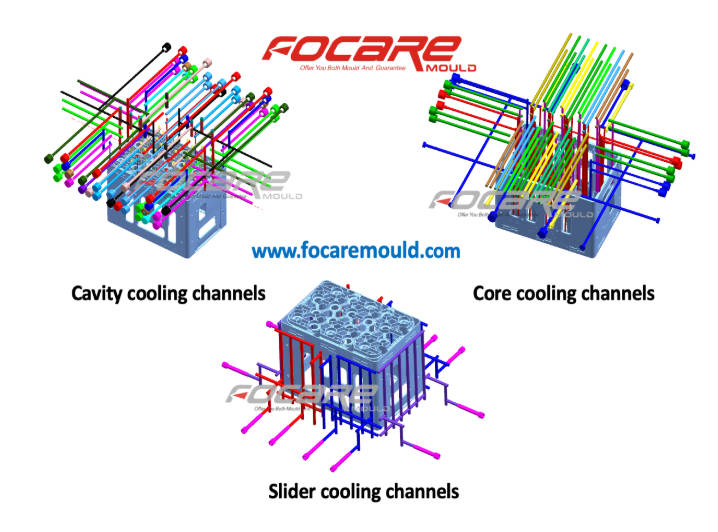
Cooling channels arranged for the cavity, core and slider areas of a beverage crate mold.
Ejection and Slider Mechanisms
Crate handles, ventilation openings and undercuts may require side sliders, lifters or other release mechanisms. Material shrinkage around the core can also influence ejection force. The mold structure must be reviewed together with the selected resin and the product’s rib and wall layout.
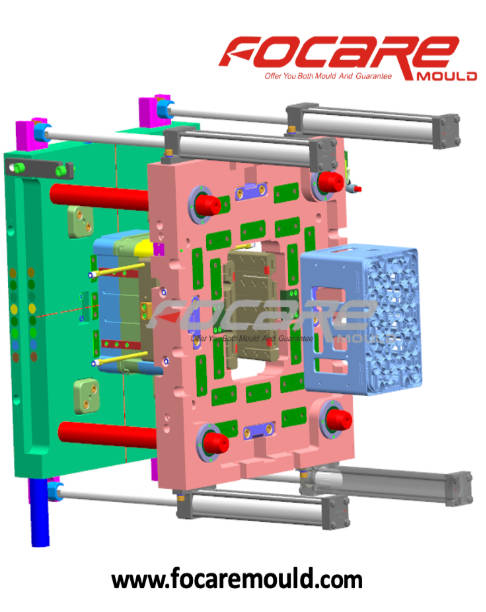
A 3D mold view showing the side-action arrangement for complex crate geometry.
Focare HDPE Beverage Crate Mold Example
Focare Mould developed a one-cavity injection mold for a reusable HDPE beverage crate. The supplied project information lists a mold size of 810 × 940 × 840 mm and a mold weight of 5,116 kg. The structure uses a BeCu core, H13 plus BeCu cavity components, a six-tip hot runner, four side sliders and four internal lifters.
The project demonstrates how material selection, cooling and release mechanisms must work together. Cycle time is not guaranteed here because it depends on the injection machine, resin grade, molding parameters, cooling-water conditions and acceptance criteria.
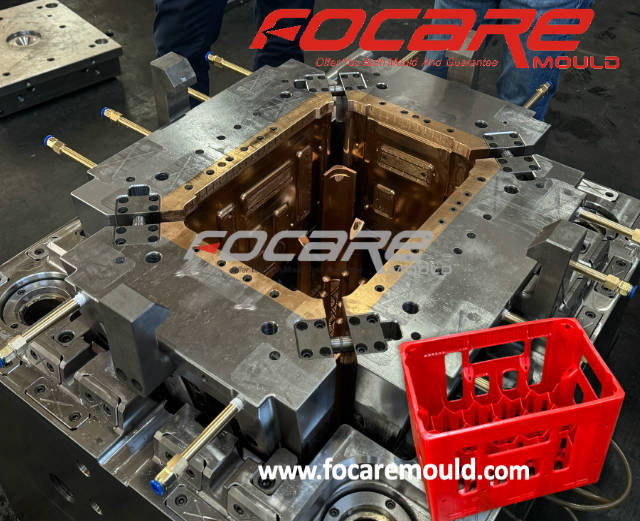
Open mold view showing the large crate cavity and surrounding side mechanisms.
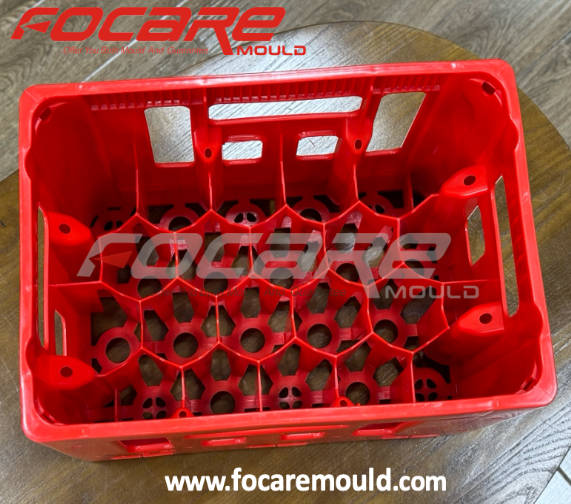
Finished beverage crate showing handles, open sidewalls and internal bottle-support geometry.
Read the full plastic beverage crate mold case study, or review the plastic beverage crate injection mold product page.
Which Material Should You Choose?
• Reusable beverage crates: HDPE is often considered for toughness and impact resistance.
• Cold-storage crates: Consider HDPE or a verified low-temperature impact grade of PP.
• Rigid industrial or household storage: PP may be attractive when stiffness and low density are priorities.
• Stackable logistics crates: Compare HDPE with impact-copolymer PP using actual load and handling requirements.
• Frequent washing: Check the real cleaning chemical, temperature, exposure time and resin datasheet.
Material Selection Checklist
• Required stacking load and expected service life
• Drop impact and low-temperature conditions
• Product weight, wall thickness and rib layout
• Cleaning chemicals and washing temperature
• Resin availability, consistency and approved additives
• Mold filling, cooling, shrinkage and ejection requirements
Conclusion
HDPE is often a practical choice for beverage crates that need toughness and low-temperature impact performance. PP can be advantageous where stiffness, low density or moderately higher temperature resistance matters. Neither material is automatically better for every crate.
Focare Mould develops custom plastic crate molds and other large injection molds based on product geometry, selected resin and production requirements. Contact our engineering team to review your crate design before finalizing material and mold specifications.
