
Plastic Beverage Crate Mold Case Study | Focare Mould
Plastic beverage crates must protect and organize bottles while supporting repeated handling, transport and stacking. Their open sidewalls, integrated handles, reinforcing ribs and internal bottle-support features create a mold structure that is more complex than a conventional storage box.
In this project, Focare Mould developed a single-cavity HDPE beverage crate injection mold with four side sliders, four internal lifters, a six-tip hot runner and dedicated cooling circuits for the cavity, core and slider areas. This case study focuses on the confirmed engineering features rather than making unsupported cycle-time claims.
Confirmed Project Specifications
• Product: plastic beverage bottle crate
• Plastic material: HDPE
• Mold configuration: single cavity
• Core material: BeCu
• Cavity material: H13 + BeCu
• Hot runner: six tips
• Mold dimensions: 810 × 940 × 840 mm
• Mold weight: 5,116 kg
• Side sliders: four
• Internal lifters: four
The supplied specifications identify BeCu in the core and H13 + BeCu in the cavity. The exact location and geometry of individual BeCu sections should be confirmed from the approved mold drawing before applying the same arrangement to another project.
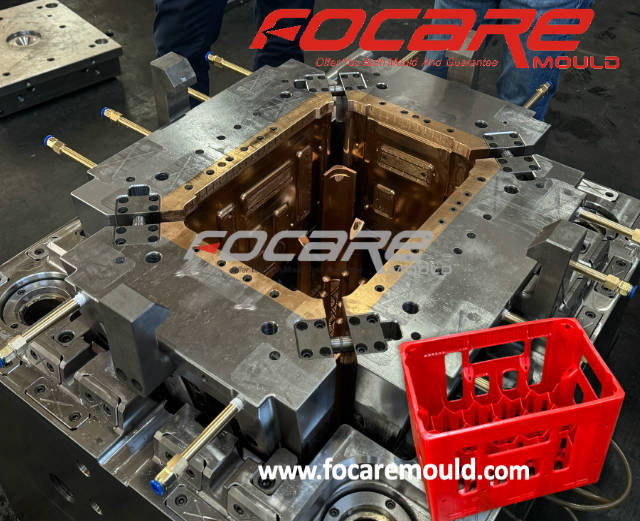
Open mold view showing the cavity, core and side-action structure.
Challenge 1: Releasing the Side Openings and Internal Features
A beverage crate includes openings on multiple sides, carrying handles, structural ribs and internal bottle supports. Several of these details cannot be released only in the main mold-opening direction, so the demolding concept must be developed together with the product geometry.
The project uses four side sliders to form and release the outer sidewall features. Four internal lifters provide additional movement for selected internal geometries. Slider connecting rods and the handle-area structure also need sufficient support because these mechanisms operate around a large molded part.
The sliders, lifters and main ejection system must move in the correct sequence without interfering with one another. Alignment, wear surfaces, travel distance and maintenance access are therefore important review points before manufacturing begins.
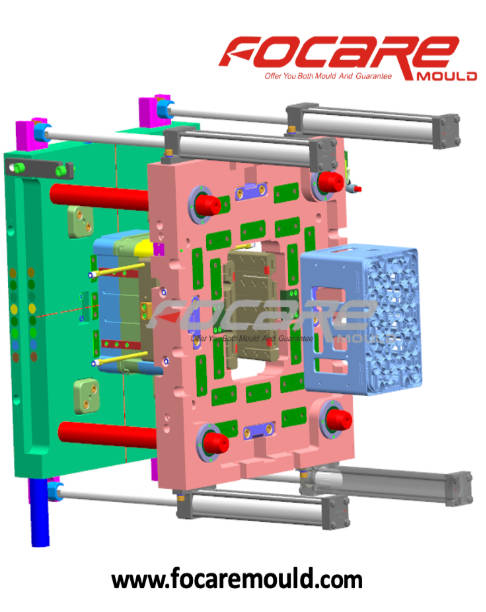
3D mold layout showing the four-side slider arrangement.
Challenge 2: Cooling the Cavity, Core and Sliders
Cooling is a central engineering issue in a large plastic crate mold. The bottom, ribs, handles and open sidewalls do not all remove heat in the same way. If temperature distribution is uneven, the molded crate may experience dimensional variation, local shrinkage or warpage after ejection.
For this project, cooling channels are planned in three major zones. Cavity cooling removes heat from the external surfaces. Core cooling manages the internal basket geometry and reinforcing areas. Slider cooling addresses the sidewall-forming components, which may otherwise operate at a different temperature from the main mold sections.
These cooling circuits must be reviewed as one system. Channel routing, flow direction, connection points, sealing and maintenance access all affect practical mold operation. Trial measurements and the actual molding conditions provide the basis for further adjustment.
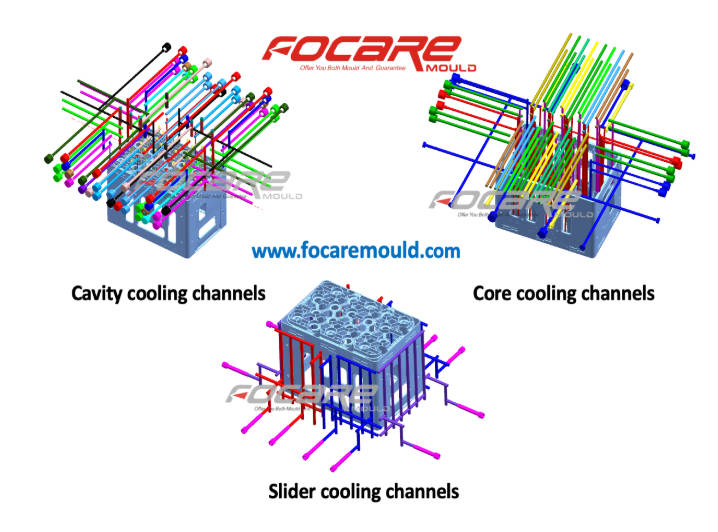
Cooling-channel layout for the cavity, core and slider components.
Six-Tip Hot Runner and Filling Balance
The confirmed mold design uses a six-tip hot runner. A large HDPE crate contains long flow paths and many ribs, so melt distribution and gate position must support balanced filling across the part.
During engineering review, the hot-runner layout should be considered together with filling pressure, weld-line locations, packing behavior, gate appearance and shrinkage. The appropriate processing window depends on the approved crate geometry, selected HDPE grade and injection-machine capability.
A hot runner can reduce cold-runner waste, but the number and position of tips should not be copied from one crate design to another without evaluation. Product size, rib distribution and bottle-support features may require a different layout.
H13 and BeCu in the Mold Structure
H13 tool steel is considered where strength and wear resistance are important. BeCu is used where improved heat transfer is required compared with conventional tool steel. Combining these materials allows the mold design to address both mechanical support and thermal management.
Material selection still depends on the individual component, expected production demand, cooling access and maintenance plan. For another crate project, steel and insert locations should be confirmed from the final design rather than treated as a standard formula.
Mold Assembly and Trial Review
After mold assembly, trial evaluation should cover the operation of all four sliders and four lifters, the release of the molded crate, filling balance and the condition of the handle and rib areas. The finished part should also be checked for dimensional stability after cooling.
This article does not publish a guaranteed molding cycle because the supplied information does not include the injection machine, product weight or complete test conditions. Cycle time should be confirmed from an actual trial using the customer's production requirements.
Finished HDPE Beverage Crate
The finished red beverage crate has an open wall structure, integrated carrying handles, a reinforced base and internal bottle-support features. These details support practical storage and handling, while also creating the undercuts, ribs and thermal differences that the mold must manage.
For beverage crate manufacturers, the product design, mold structure and production equipment should be evaluated together. Small changes to the openings, handles or bottle layout may influence slider travel, cooling and filling behavior.
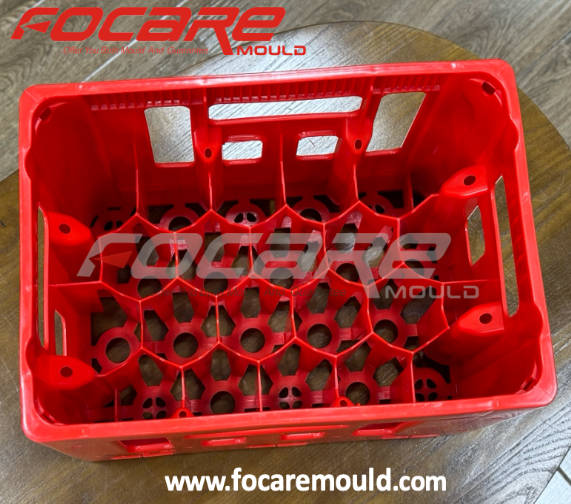
Finished HDPE beverage crate with internal bottle-support and reinforcing features.
Project Review with Focare Mould
For a custom plastic crate mold review, please provide the 3D product drawing, selected HDPE grade, crate and bottle dimensions, stacking requirements, expected output and injection-machine information. Focare Mould can then evaluate the cavity structure, sliders, lifters, hot runner, cooling and ejection concept for the specific application.
As a plastic injection mold maker in China, Focare Mould develops beverage crate molds, industrial crate molds, household storage molds and other large plastic injection molds. Visit the related plastic beverage crate mold product page for the product-focused overview.
Send your crate design to Focare Mould for a project-specific mold review and quotation.
