
| Phone : | +886-932876644 |
|---|---|
| Fax : | +86-576-84335172 |
| Email : | sale@focaremould.com |
7.5L Plastic Bucket Injection Mold Case Study – Air Ejection Design
7.5L Plastic Bucket Injection Mold Case Study – Air Ejection and Hydraulic Core-Pulling
Deep plastic containers can present significant molding and demolding challenges. After cooling, the molded part may shrink around the core, while the deep cavity can increase vacuum resistance during release.
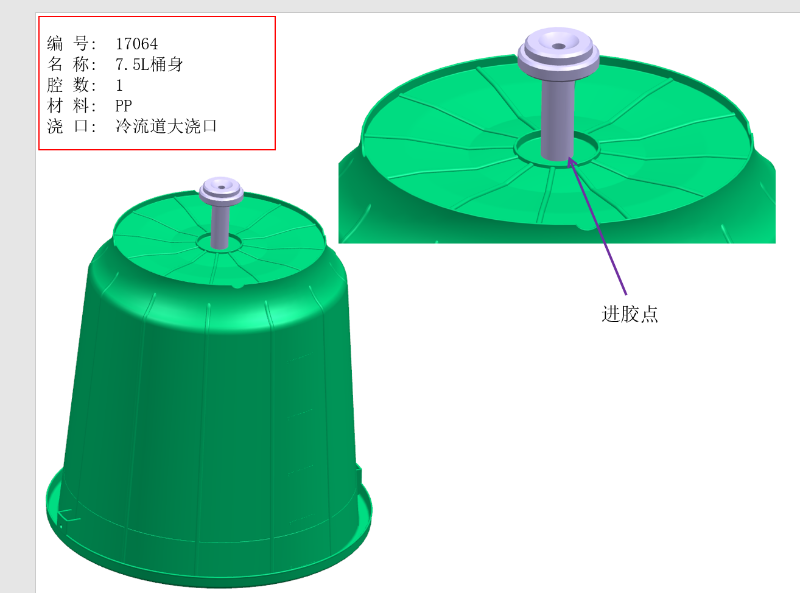
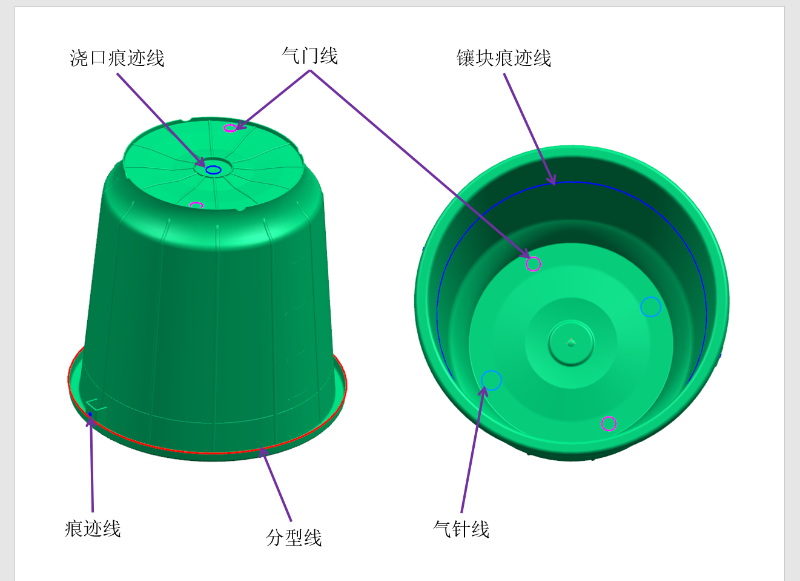
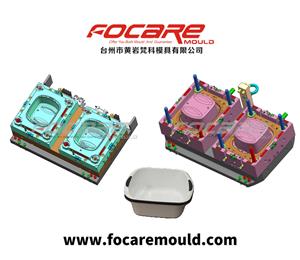
For project 17064, Focare Mould developed a 7.5L plastic bucket injection mold for a polypropylene bucket body. The engineering drawings show a central cold runner gate, planned surface-mark locations, air-assisted demolding components and hydraulic core-pulling mechanisms.
Project Specifications
Project number: 17064
Product: 7.5L plastic bucket body
Material: PP
Mold cavities: 1
Runner system: Cold runner
Gate type: Large gate
These specifications apply only to this documented project. Final specifications for a new bucket mold should be confirmed according to its product geometry, selected resin grade, injection machine and production requirements.
Challenge 1: Gate Location and Filling Design
The CAD design shows a centrally positioned gate at the bottom of the bucket. A large cold runner gate introduces the melt into the deep bucket-shaped cavity.
For this type of product, the gate position affects the melt-flow direction and the distance the material must travel before reaching the upper sections. The gate dimensions and molding parameters must therefore be evaluated according to the PP grade, wall thickness, product structure and injection-machine conditions. The drawing also identifies the expected gate-mark position so its location can be reviewed before manufacturing.
Challenge 2: Surface Marks and Parting-Line Review
A plastic bucket may appear simple from the outside, but the necessary gate, inserts and demolding components can leave visible traces on the finished product.
The product analysis identifies the planned locations of:
Gate marks
Air-valve marks
Air-pin marks
Insert lines
Parting lines
Showing these locations in the engineering drawings allows the customer to evaluate whether the visible traces are acceptable before steel machining begins. This review is particularly important when appearance requirements apply to specific surfaces.
Challenge 3: Venting for a Deep Bucket Cavity
As PP fills the deep cavity, displaced air needs a controlled path to escape. The venting concept should be reviewed together with the melt-flow direction, parting line and insert layout. Vent dimensions and locations must be selected according to the product geometry, resin and molding conditions, while final venting performance must be verified during mold trials.
Challenge 4: Air-Assisted Demolding
Demolding is a central engineering concern for a deep plastic bucket. During cooling, the PP bucket can shrink around the mold core, and the deep shape may create vacuum resistance as the product begins to separate.
The mold design therefore incorporates air valves and air pins. Compressed air can assist separation from the core and help break the vacuum during the release sequence. The air-component positions must be coordinated with the bucket geometry, visible surfaces and the overall ejection arrangement. Air assistance supports the demolding strategy but does not replace appropriate draft and ejection design.
Challenge 5: Hydraulic Core-Pulling Mechanisms
The CAD assembly also shows hydraulic-cylinder-driven core-pulling mechanisms. The cylinder arrangement must consider the available mold space, moving clearances, connection points and the required operating sequence.
When air-assisted release and hydraulic movements are used in the same mold, the sequence must be evaluated as one coordinated system. Accurate positioning and controlled movements are important for preventing interference between the molded bucket and moving mold components.
Engineering Value of the Project
This case demonstrates that the engineering difficulty of a plastic bucket mold cannot be judged only from the product's external appearance. The deep cavity, centralized gating, surface-mark requirements, venting, air-assisted demolding and hydraulic movements influence one another and should be reviewed together during DFM and mold design.
The available drawings document the selected engineering arrangement. Because no T1 trial report or production data was provided for this article, no claims are made regarding cycle-time improvement, final production stability or customer acceptance. Actual molding performance must be established through mold trials and product inspection.
Plastic Bucket Mold Manufacturer in China
Focare Mould develops customized plastic bucket injection molds for household containers, storage products and industrial plastic components. As a plastic injection mold maker in China, Focare supports customers with product evaluation, DFM communication, mold design, manufacturing, assembly and mold trials.
For deep-container projects, customers can provide product 3D files, the selected resin grade, target injection machine, appearance requirements and production needs for engineering evaluation.
